A Viking in Downtown Boston
Traditionally, statues in Boston are of a President, Patriot, General, Civic Leader or illustrious Bostonians. But at the far end of the Commonwealth Avenue Mall (Kenmore Square side), stands a life-sized statue of Lief Ericsson, who was none of the above!
Lief Ericsson is believed to have traveled to North America, from Iceland and Grenland, and establish a colony in Newfoundland which he called Vineland. (You can see the remains of this colony in Western Newfoundland – almost Labrador.) In the late 1800’s there was a revival in interest in finding evidence of viking visits to North America – hence the statue. In fact there is also a carving of a viking ship on one of the bridges crossing the Charles River. It was erroneously believed that the remains of a boat found underwater were in fact those of a viking ship. Sad to say, that was not the case.
But back to Lief and the statue.
The statue was made in 1887 and is one of, if not the, oldest statues of Lief Ericsson in North America. The statue was sculpted by Ann Whatley one of the few women sculptors of her day. Finally, the statue has Leif facing west – looking for North America. Or maybe he’s looking for Fenway Park to see how the Red Sox are doing?
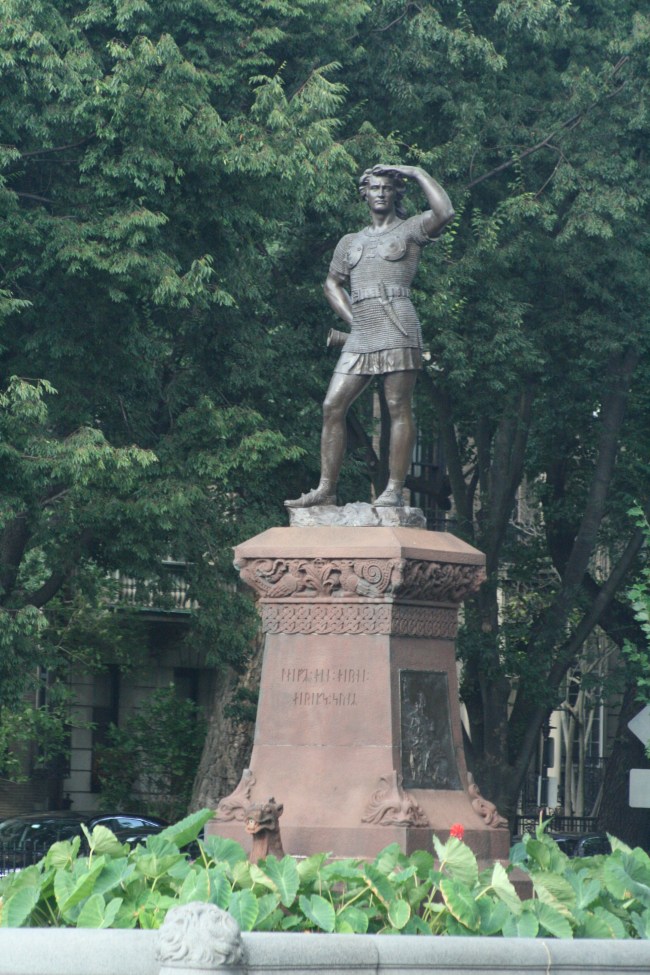 Combining the visit to Lief with a visit to Momma Duck and her ducklings (from Make Way for Ducklings) at the Garden end of the mall is a great opportunity to provide a little known piece of history to visitors, as well as seeing many other statues. And it is a very enjoyable 9-10 block walk.
Kayaking in Portsmouth Harbor
Down the creek (and up it too) WITH a paddle
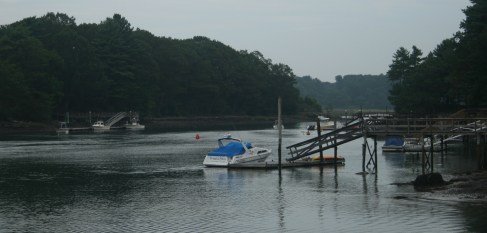 Sagamore Creek is one of several creeks that empty into the Piscataqua River and ultimately Portsmouth harbor. A small one-story building on Route 1-B is the home for Portsmouth Kayak Adventures. Taking a kayak trip down the Sagamore Creek provides a very different perspective on the strength of the tides in the harbor.
The 2½ hour tour starts when kayaks are put in the water from the ramp. The aim is to time the tides so that you are going out with the tide and paddling back up the creek with the incoming tide.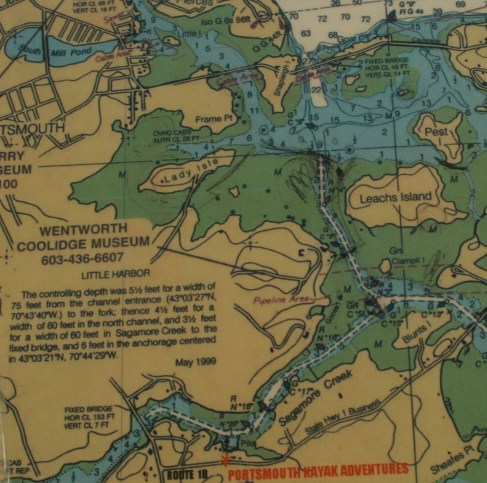
Paddling gently down the creek, the shore is teeming with bird life and dotted with the occasional house. Many of the birds are seagulls with some mallards. However,around and between the various islands at the mouth of the creek (which is the entrance to the river), the variety increases. The guide pointed out a Bald Eagle nest but the family, unfortunately, wasn’t home. On the other side of the island, there were seven Great Blue Herons fishing on the beach. As we approached them, they tookoff in flight and relocated themselves 50 yards further down the beach. This approaching and relocating was repeated twice.
Leaving the islands behind, the kayaks cross “open water” to the entrance to Little Harbor while keeping an eye out for boats entering and exiting the harbor. On the right is the old Navy Prison – a multi-story building presently closed. Prior to that one passed the Marriott Hotel Resort and Day Spa on Newcastle Island. The houses now start to get much bigger. One of the houses had been bought for $10 million, our guide told us.
After passing under a bridge you enter the Little Harbor. From the point of view of the kayak, there is not much that is little about this harbor. Docks are spread over the waterfront with the lobster boats moored beside. Many of the houses are made with shingles and painted bright colors – the classic New England Fishing Village. But seen from a kayak not a large boat!
The return is by a different route. The water is too shallow to allow navigation between the islands. There is a large sandbank crowded with seagulls.
The return did not catch the incoming tide. It was not quite at low tide yet. This leads to a strenuous upper body exercise. Amazing how strong a 2-3 mile per hour current can be when going against it. Arriving at the ramp, the kayaks are taken out, life jackets returned to their place and the tour is over.
However, right next-door is B.G.s Seafood restaurant. Sitting outside on the balcony, facing downstream, is the best way to enjoy a meal or snack and reflect upon the kayak ride down the creek and into the harbor.
Friesians spotted in Vermont
Outside of Townsend, at the end of Maggie Ladd Road, are the Friesians. What are Friesians and what are they doing in Vermont?
Friesians are horses, but to say that Friesians are horses is to say that a Rolls Royce is a car. Friesians are rather large (up to 17 hands at the top of the shoulder) horses with a colorful history. The breed originated in the Netherlands. During the Middle Ages they were used as war horses capable of carrying a knight in armor. At several times in its history, the breed almost became extinct.
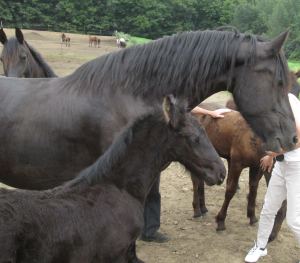 Friesians are recognized by their shiny black color, long, thick mane (often braided!) and tail, and what are called “feathers” (long black hairs left uncut on purpose) on the lower legs. However, when they are born, their coat is a brown, almost down-like and fuzzy in texture. This coat eventually changes and becomes the classic black. The Friesian walks and canters with an elegant and distinguished gait – reminds one of a Tennessee Walking Horse or a Spanish “Caballo de Paso Fino”.
Many people may have seen these horses without recognizing them. Friesians have appeared in several movies (e.g., The Mask of Zorro, Alexander, The Chronicles of Narnia). Most recently they had an appearance in The Hunger Games Tribute Parade.
So how did they get to Vermont? Robert Labrie was in the construction/road maintenance business. 15 years ago, he and his wife Laurie sold that business and started exploring what to do next. They had a small farm with three stalls and Bob decided to get into the “horse business”. He went to the Equine Affaire, and fell in love with the Friesians he saw there. The rest is history. To quote Laurie, “The three stall venture now has 88 horses” and is called “Friesians of Majesty”.
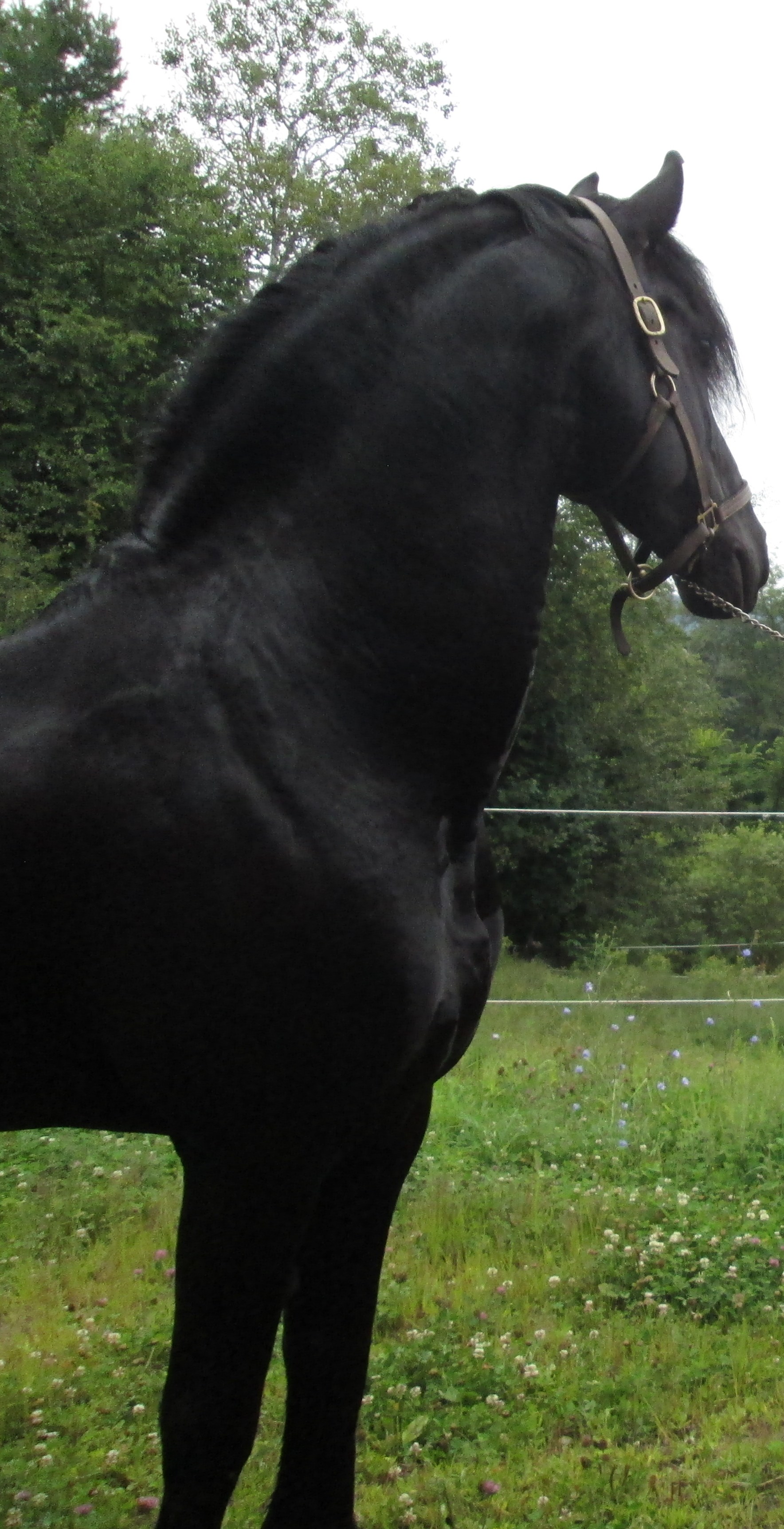
The star at Friesians of Majesty is Othello. He has received the highest award for a Friesian Stallion (FPZV 1st Premium Approved Stallion) and is a beautiful but also very gentle animal. He stands 17 hands tall, a dark black color with a striking mane, tail and feathers. Watching the horse walk and canter is like watching a concert pianist playing a Beethoven piece – full of energy while moving gracefully over the ground, feet rising and falling in cadence.
The farm provides a variety of activities for visitors including: training, riding lessons, driving lessons, camps for girls and women, carriage rides and in the winter sleigh rides through the woods and fields. Riders are of all ages.On certain dates they put on a Majestic Friesian Performance. This show put to music demonstrates how the Friesians are used for riding and for driving. The performance schedule can be found at the website http://www.friesiansofmajesty.com/. Reservations are required.A tour of the farm represents a unique opportunity to see and interact with some beautiful horses, and learn about them while visiting southern Vermont. Well worth the trip.
 pwtravels
Recent Comments